
What traffic does CompareIT expect?
CompareIT does not depend on one channel. It sits across six largely independent UK demand pools — organic search (SEO), AI answer engines (AEO), paid social and search (PPC), addressable TV (Sky AdSmart), automated high-intent signal detection (“AI Agents”), and a referral network of trusted advisers (Affiliates). Each is sizeable on its own; together, and growing every year, they represent a materially larger and more durable opportunity than any single-channel MSP marketing plan.
Watch the Go-To-Market approach that's changing the game for MSPs.
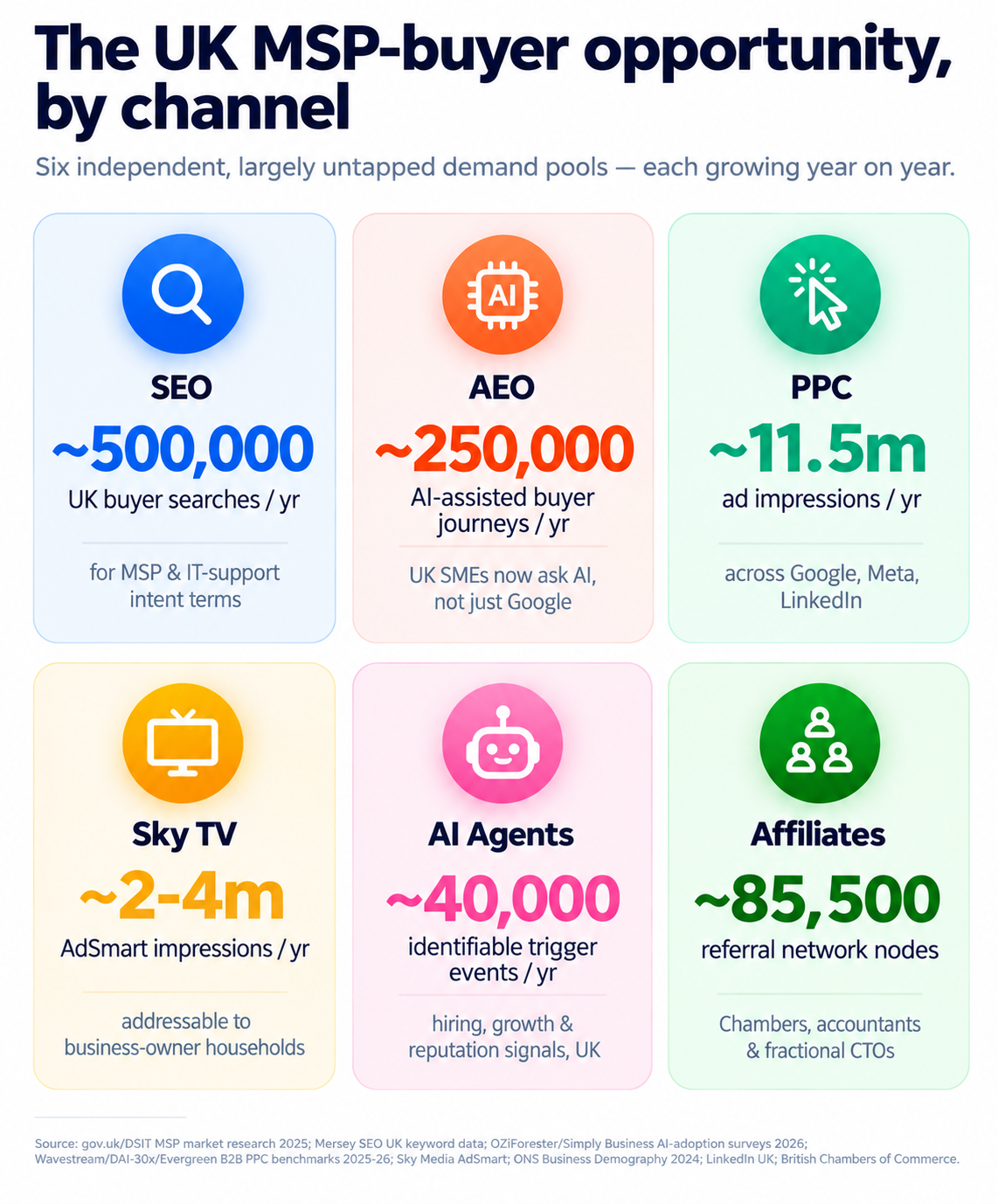
Fig. 1 — Total addressable demand per channel, UK, annualised central-case estimate. Full sourcing in Methodology & Sources.
The core UK search cluster for MSP-buying intent alone runs to roughly 500,000 searches a year once “near me”, city-level, and long-tail permutations are included — and that is before AI answer engines, which UK SME owners now use for business research at nearly 1 in 2 (47%), are counted separately. Paid channels add millions more addressable impressions on demand; Sky AdSmart alone can put a brand in front of 2–4 million business-owner-household impressions a year and the AI Agent and Affiliate channels tap tens of thousands of identifiable, already-in-market UK SMEs that no keyword search will ever surface.
None of these channels is static. Search volume for MSP-related terms is rising as more SMEs outsource IT; AI-assisted research adoption has more than doubled among UK SME owners in a single year; and the pool of high-growth, newly-staffed and dissatisfied SMEs (the AI Agent triggers) renews continuously. The opportunity is not a one-off spike — it compounds.
The 3-year opportunity, channel by channel
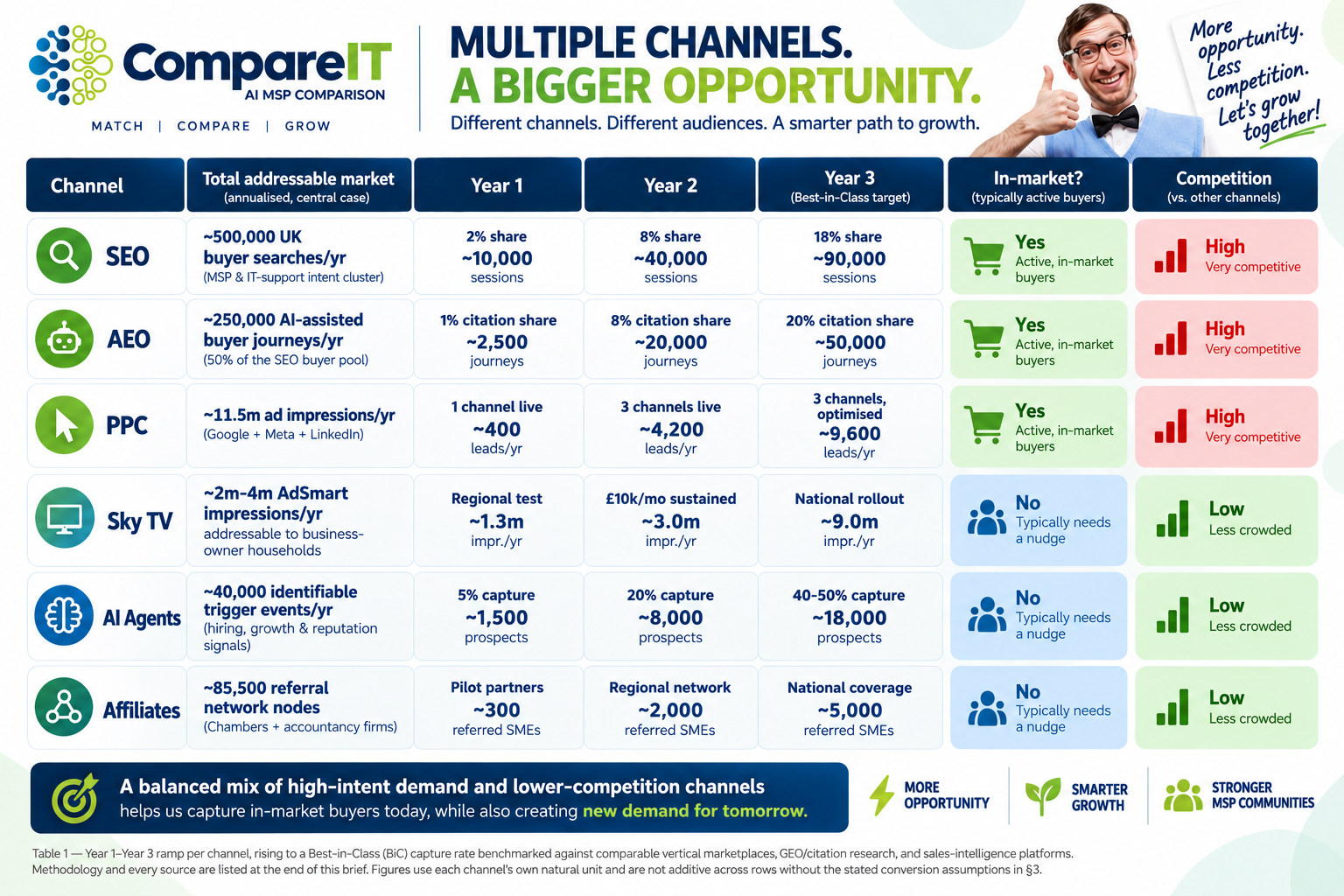
Table 1 — Year 1–Year 3 ramp per channel, rising to a Best-in-Class (BiC) capture rate benchmarked against comparable vertical marketplaces, GEO/citation research, and sales-intelligence platforms. Methodology and every source are listed at the end of this brief. Figures use each channel’s own natural unit and are not additive across rows without the stated conversion assumptions.
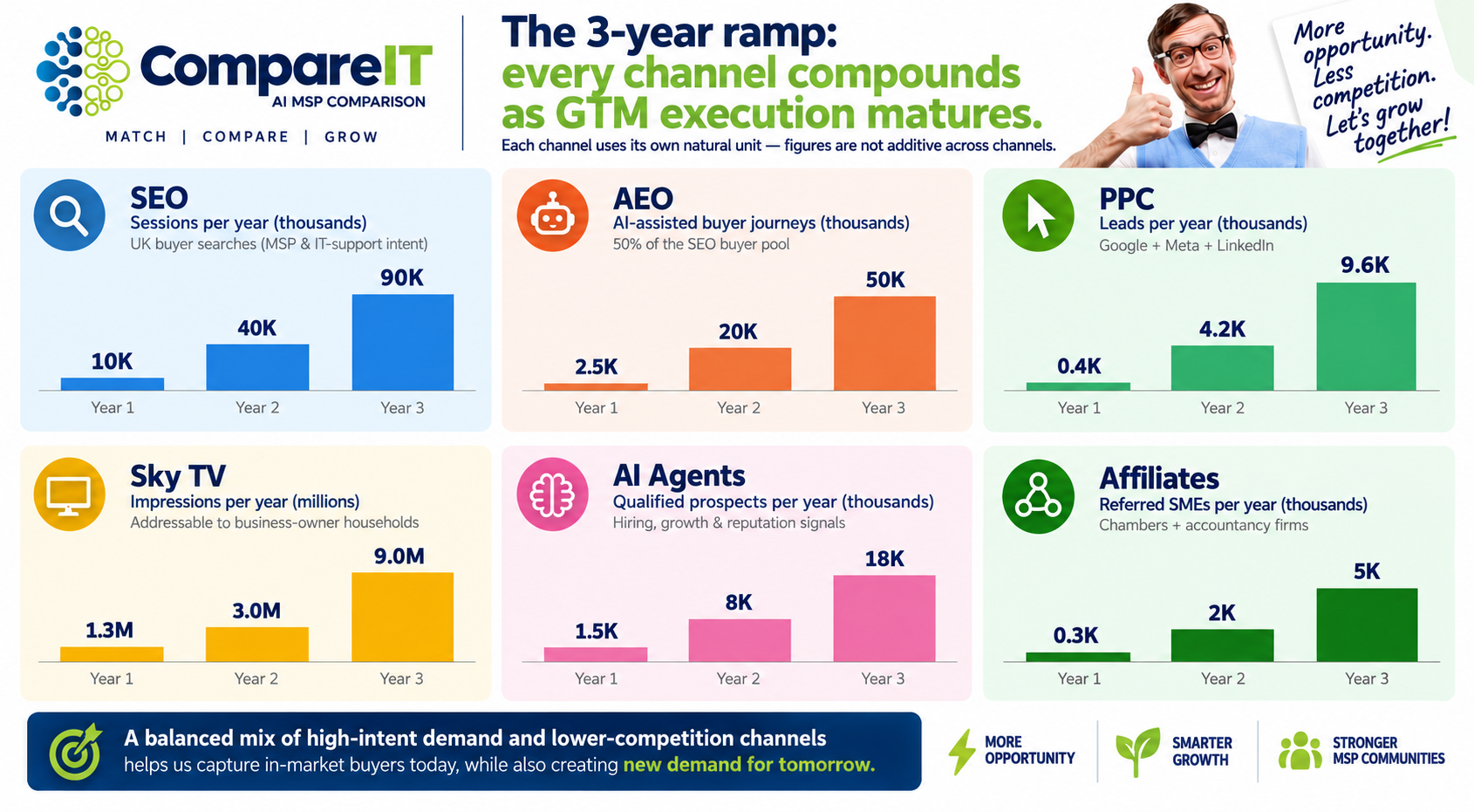
Fig. 2 — The same ramp, visualised. Every channel compounds as CompareIT’s go-to-market execution matures from launch (Y1) to Best-in-Class (Y3).
How will CompareIT change buyer behaviour?
Buyer behaviour has already moved. UK SME owners researching a new IT partner are no longer relying only on organic listings and sponsored ads — they are increasingly asking an AI assistant directly.
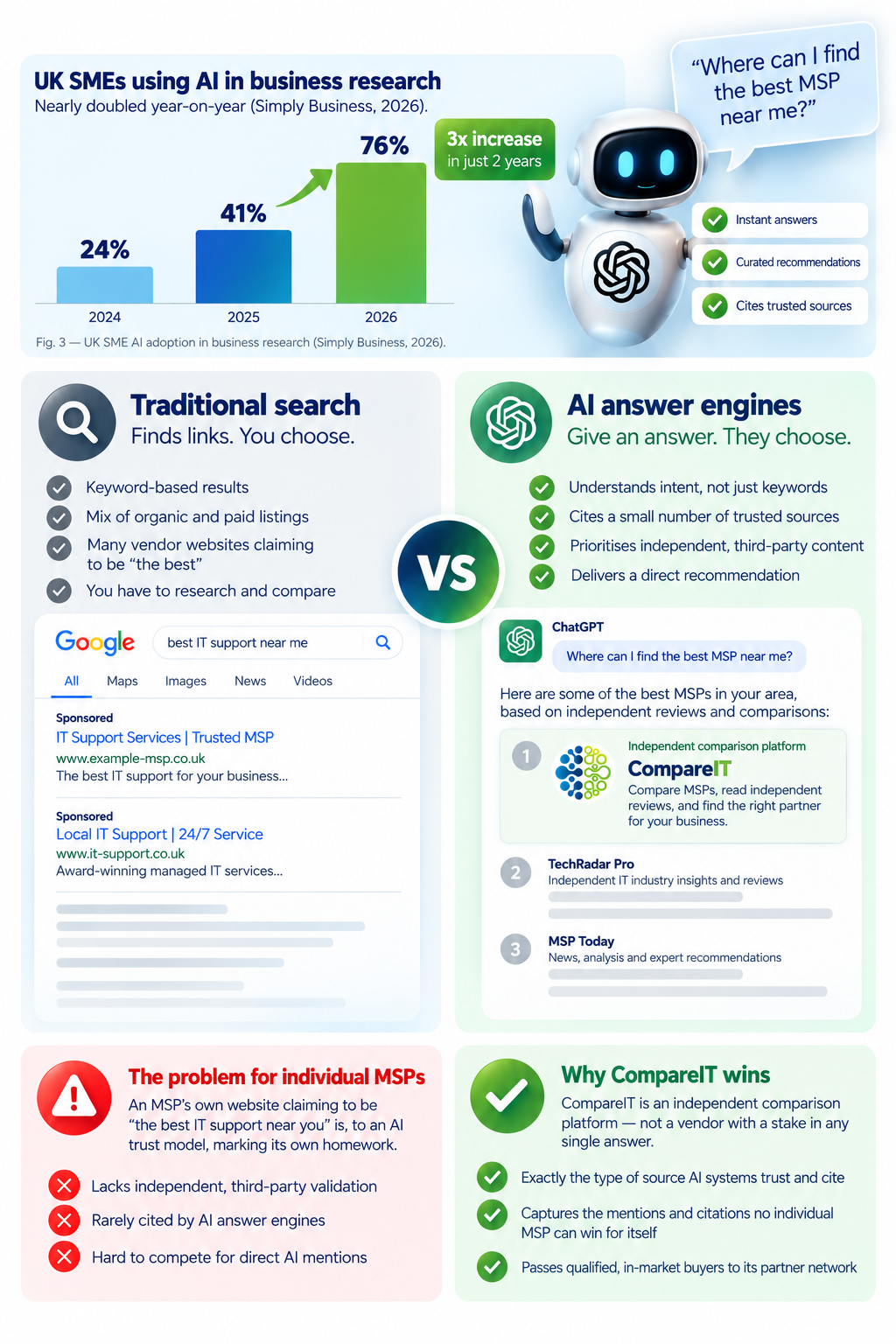
This is not a cosmetic shift. It changes the game from ranking on search terms to being mentioned and cited. When an AI assistant is asked “where can I find the best MSP near me?”, it does not run a keyword auction — it decides which sources it trusts enough to repeat. Research into generative-engine citation behaviour shows AI systems concentrate their citations on a small number of trusted, independent, earned-media sources rather than spreading them evenly across every vendor website.
That is precisely the problem for an individual MSP: an MSP’s own website claiming to be “the best IT support near you” is, to an AI trust model, marking its own homework. It carries none of the independent, third-party signal that AI systems are built to look for.
CompareIT is structurally the opposite. As an independent comparison platform — not a vendor with a stake in any single answer — CompareIT is exactly the type of source AI answer engines are already inclined to trust and cite. That lets CompareIT capture the mentions and citations that no individual MSP can credibly win for itself, and pass qualified buyers through to its partner network instead.
How many enquiries should an MSP expect from CompareIT?
Enquiry volume ramps with the same curve as Table 1, because it is driven by the same growing GTM execution: more content and domain authority (SEO), more AI citations (AEO), fuller paid budgets run more efficiently (PPC and Sky), broader signal coverage (AI Agents), and a wider partner network (Affiliates).
Applying standard B2B conversion benchmarks to the search-driven channels, and combining every enquiry-generating channel (excluding Sky TV, which is a brand-awareness reach channel with no published click/enquiry benchmark), the platform-wide qualified-enquiry pool by Year 3 is approximately:
● PPC: ~9,600 leads/yr (optimised 3-channel spend)
● AI Agents: ~18,000 qualified prospects/yr (40-50% signal capture)
● Affiliates: ~5,000 referred SMEs/yr (national partner coverage)
● SEO: ~2,700 enquiries/yr (90,000 sessions × ~3% typical B2B conversion)
● AEO: ~2,500 enquiries/yr (50,000 AI-cited journeys × ~5% — higher intent, pre-filtered by the AI recommendation itself)
~38,000 qualified enquiries per year platform-wide by Year 3 — up from a low-thousands run rate in Year 1 while the channel mix and partner network are still being built out.
Enquiries are not allocated exclusively. Each qualified opportunity is issued to whomever the buyer selects. On average we see three partner MSPs reviewed per event, so that the buyer receives a genuine side-by-side comparison and the partner receives a competitive, not captive, lead. On that basis, 38,000 qualified enquiries a year generate roughly 114,000 partner issuances (38,000 × 3). Spread across a partner network of 1,000 MSPs nationally by Year 3, that is approximately 114 qualified enquiries per partner per year — around 9 to 10 a month — before accounting for regional or specialism-based routing, which would concentrate volume further for partners in high-demand areas or niches. The precise per-partner number depends on two policy choices: the size of the partner network and the number of partners each opportunity is issued to. The platform-wide total in Table 1 is the reliable number; the per-partner split follows from those two assumptions, not from research.
4. Why couldn’t an MSP get these results themselves?
Three reasons compound against a single MSP trying to replicate this.
It requires a dedicated team, skill set and budget most MSPs don’t carry
Running six channels well — technical SEO and content, generative-engine optimisation, three distinct paid-media platforms with different auction dynamics, addressable TV media buying, signal-based prospecting, and a referral partnership function — is a multi-disciplinary marketing operation, not a task for a part-time marketing hire inside a 20-50 seat MSP. Most MSPs already spend their commercial budget and attention on service delivery and vertical specialisation, not on building and maintaining a six-channel demand-generation function from scratch.
Independence cannot be faked
As set out in §2, the AEO advantage specifically requires being independent of any single MSP. A vendor cannot self-certify its own trustworthiness to an AI system, or to a buyer who has learned to be sceptical of vendor claims. Only a comparison platform structurally outside the vendor relationship can hold that position — no amount of individual MSP budget changes that structural fact.
Buyers already expect this experience — and are actively looking for it
SME buyers increasingly want the same independent, side-by-side comparison experience they have grown used to in consumer markets for insurance, energy and financial products, applied to a decision as consequential as who manages their IT and cyber security. That expectation exists whether or not any individual MSP chooses to meet it — the only question is which company builds the independent layer buyers are already looking for.
5. Why will lead quality on CompareIT surpass traditional MQL conversion?
Every other UK lead source available to an MSP today — web enquiry forms, cold outreach, generic directory listings, most paid campaigns run in isolation — delivers a raw contact that still has to be run through a marketing-qualification and sales-qualification process before it is worth a salesperson’s time. None of them are ICP-matched or BANT-qualified at the point of arrival.
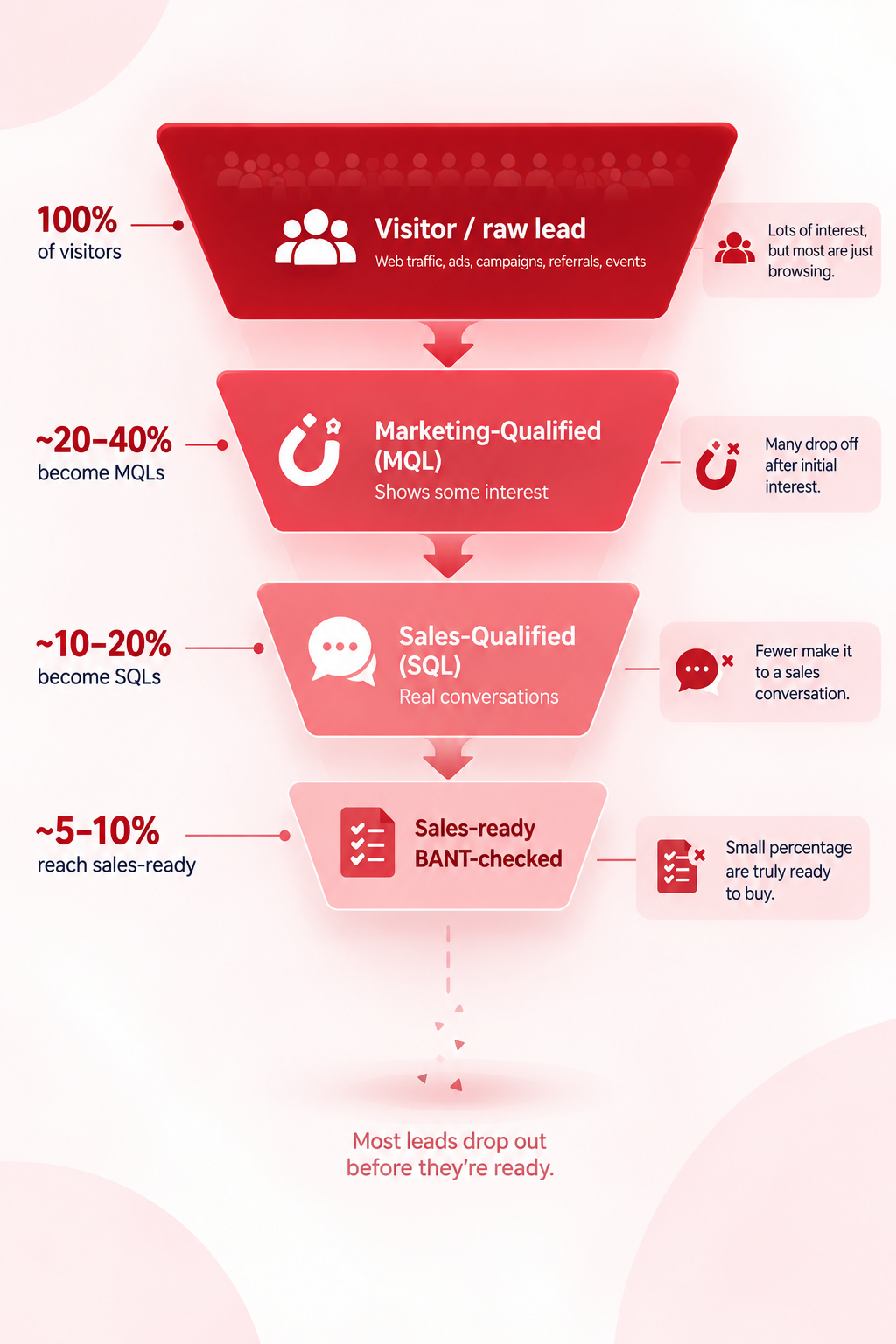
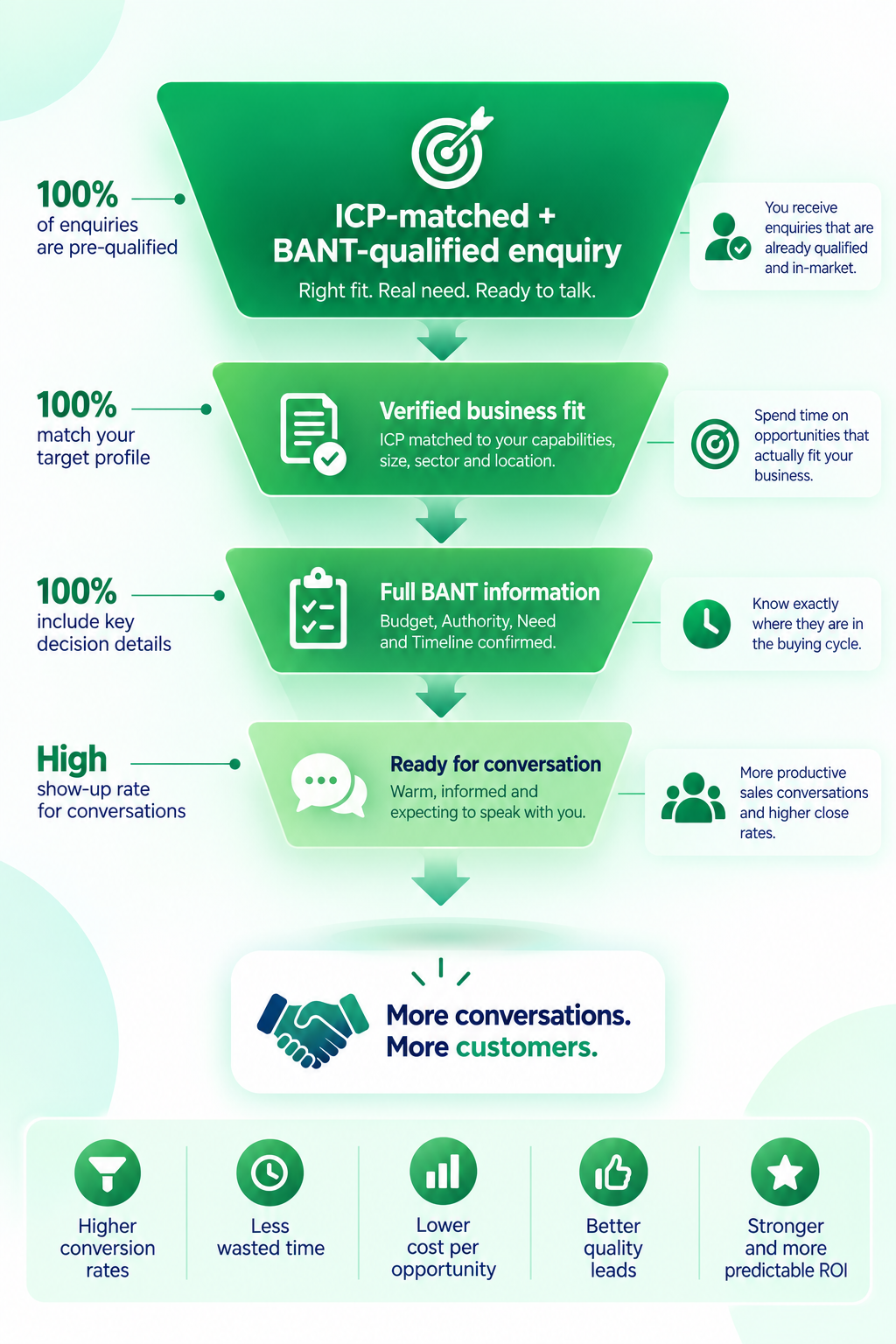
Fig. 4 — Conceptual comparison. Every other channel starts an MSP’s funnel from the top; CompareIT enquiries arrive already qualified.
CompareIT is built to qualify before it refers, not after. By matching buyer profile against Ideal Customer Profile criteria and checking Budget, Authority, Need and Timeline before a lead is ever routed to a partner MSP, CompareIT enquiries skip the top-of-funnel and MQL stages that every other channel still has to pay for in sales time. That is the structural reason lead quality — not just lead volume — is expected to outperform traditional MQL conversion: CompareIT is the only UK platform in this category providing that level of qualification before the handoff, not after it.